My blog has been moved to ariya.ofilabs.com.

Wednesday, August 18, 2010

box of marbles redux

If you enjoy the box of marbles demo, now we extend it to include some basic network support. The premise is simple, look at this short video first (or watch on YouTube):

The code to handle the physics of the marbles remains the same, i.e. we just use Chipmunk physics engine. However, I added a simple feature to transfer marbles from one place to another. To keep it simple, it is done using UDP. The Qt network module supports UDP quite well, making the datagram code short and readable.

The intended use of this example is easy: run the desktop version and then run the mobile version (tested with Nokia N900). Each instance should find each other and start communicating. Again, we simplify the situation here and handle only 2 (two) peers. To facilitate troubleshooting, the application window title will contain the network address information, if the two peers are fully connected. To avoid complicated setup, discovery is carried out automagically through broadcast. This makes such a demo runs only under the same subnet, which is not a big deal.

It would have been much more fun doing the transfer between two smartphones (instead of a phone and my laptop). However, I own only one Nokia N900. Hint: I will not refuse your donation of Nokia N8 or (preferably) MeeGo-powered Nokia N9 (i.e. the N900's successor, whatever the real name is).

If you want to give it a try, head to the usual X2 repository and look at demo/marblenet subdirectory. Again, have the patient to follow the README file before you start compiling it.

Of course, feel free to extend this example to suit your (more wild) fantasy!

Wednesday, August 11, 2010

adventure to the land of green tea

Now I work for Sencha, the company behind the leading JavaScript frameworks such as Sencha Touch, Ext JS, Ext GWT, Ext Designer, jQTouch, Raphaël, Connect, which empower developers to create, deploy and optimize application using web-standard technologies (HTML5, CSS, JavaScript). Beside, it's a hot startup to work for.

quattro cinque

It's released!

Tuesday, August 10, 2010

box of marbles

The next logical step after simple bouncing ball example is something which uses a real, full-featured physics engine. Box2D is usually the popular choice. Combining Box2D with Qt has been done by many people, recently demonstrated before by Andreas and Thorbjørn. I decided to pick something else, i.e. Chipmunk physics engine.

Because this is supposed to an example, I tried to make it as simple as possible (you'd be able to extend it, once you grab the basics). Basically we have a box full of colorful marbles (yes, I loved to play marbles when I was a kid, there was not any PlayStation back then). A mouse click, or a screen tap, will generated a new marble with a random color. If you run the example on Nokia N900, you can control how the marbles move and hit each other by tilting and shaking the phone.

Check the code yourself at the usual X2 repository under the demo/marblebox subdirectory. Make sure you open and follow the instructions in the included README file.

For a sneak peek, just watch this video (or enjoy on YouTube).

There is still a sequel to this marble box. And still with Chipmunk.

what is it with this froyo obsession

Eclair still rocks :)

Eclair

Monday, August 09, 2010

bouncing ball with accelerometer on N900

First of all, I apologize for my laziness in updating X2 with new code example. I have actually written quite a number of interesting examples, some of which have even been shown back in March, during my talk at Bossa Conference 10, though I did not find the time to clean up and polish them. Although I'd face new challenges in my upcoming adventure, I am quite confident I will reach the designated rate of new X2 example fortnightly.

Now let's focus on the newest example: a minor modification to the previous accelerometer code on Nokia N900 [1]. There has been confusion with my statement there: put this function is a separate thread. This is the alternative to a non-blocking D-Bus code. The main goal of course is not to be able to get faster acceleration values per second, it is only to prevent your code from being blocked by the synchronous D-Bus call.

Rather than just updating the code with the threaded version, I also added some high-school Newtonian physics. Instead of boring sliders, you'll get a ball which moves based on the acceleration [2], i.e. it follows the gravity if you keep your N900 straight.

Here is the obligatory video. Or watch directly on YouTube.

The code can be found in the X2 repository under the sensor/bouncingball subdirectory.

In the next installment, we will integrate a third-party real physics engine and make the example more alive!

[1] Another approach is to use Qt Mobility. However, QTMOBILITY-381 (which was spawn from QTMOBILITY-326) has not been solved yet (as of today).
[2] The overall math is not too scientifically correct, but hey, I always need to leave out something, for your homework :P

Friday, August 06, 2010

even LOST has its season finale

the final countdown

Today is my last day at Qualcomm.

It still feels like yesterday when I set foot in this continent, started some fun with X2, enjoyed Brazil, had this meet-up in Cupertino, did little exploration around San Diego, and then got blessed with a cute boy. Time really flies. Now it's already time to move on, again (though this time without a geeky resignation).

I will miss Snapdragon (the pictured HTC EVO is powered by the said platform). Or any other dragons.

Those who are annoyed by a certain obsession of mine probably can guess where I'm heading to. In the grand mission of inspiring and pushing developers to write better and more exciting applications, a particular productivity barrier needs to be broken. And I dropped enough (subtle) hints in my previous blog entries already.

Stay tuned.

Monday, August 02, 2010

crowdsourcing for the win

In some news, MapQuest embraces OpenStreetMap, launches the maps site at open.mapquest.co.uk using the data from OpenStreetMap, as well as sets aside $1 million funding to improve the maps situation in USA. Let's see if other maps services will follow.

Friday, July 16, 2010

var Adam = new Child(Ariya);

> Adam.prototype
Human
> Adam.timestamp
1279148700
> Adam.length
50.17
> Adam.weight
3.4
> Adam.health
Checking.... Good
> Adam.mother.health
Checking... Good
> Adam.father.status
"Happy"

Friday, July 09, 2010

faster quaternion multiplication

Sweet memories, it was fun to derive it.

Faster here however must be taken with a grain of salt as the new code is not always guaranteed to be better pipelined.

And of course, it's trivial to beat this generic C code with architecture-specific hand-rolled assembly.

git show cbc22908
commit cbc229081a9df67a577b4bea61ad6aac52d470cb
Author: Ariya Hidayat 
Date:   Tue Jun 30 11:18:03 2009 +0200

    Faster quaternion multiplications.
    
    Use the known factorization trick to speed-up quaternion multiplication.
    Now we need only 9 floating-point multiplications, instead of 16 (but
    at the cost of extra additions and subtractions).
    
    Callgrind shows that the function now takes 299 instructions instead of
    318 instructions, which is not a big win. However I assume the speed-up
    has a better effect for mobile CPU, where multiplications are more
    expensive.
    
    Reviewed-by: Rhys Weatherley

diff --git a/src/gui/math3d/qquaternion.h b/src/gui/math3d/qquaternion.h
index 55c871d..9a1b590 100644
--- a/src/gui/math3d/qquaternion.h
+++ b/src/gui/math3d/qquaternion.h
@@ -198,24 +198,17 @@ inline QQuaternion &QQuaternion::operator*=(qreal factor)
 
 inline const QQuaternion operator*(const QQuaternion &q1, const QQuaternion& q2)
 {
-    // Algorithm from:
-    // http://www.j3d.org/matrix_faq/matrfaq_latest.html#Q53
-    float x = q1.wp * q2.xp +
-                    q1.xp * q2.wp +
-                    q1.yp * q2.zp -
-                    q1.zp * q2.yp;
-    float y = q1.wp * q2.yp +
-                    q1.yp * q2.wp +
-                    q1.zp * q2.xp -
-                    q1.xp * q2.zp;
-    float z = q1.wp * q2.zp +
-                    q1.zp * q2.wp +
-                    q1.xp * q2.yp -
-                    q1.yp * q2.xp;
-    float w = q1.wp * q2.wp -
-                    q1.xp * q2.xp -
-                    q1.yp * q2.yp -
-                    q1.zp * q2.zp;
+    float ww = (q1.zp + q1.xp) * (q2.xp + q2.yp);
+    float yy = (q1.wp - q1.yp) * (q2.wp + q2.zp);
+    float zz = (q1.wp + q1.yp) * (q2.wp - q2.zp);
+    float xx = ww + yy + zz;
+    float qq = 0.5 * (xx + (q1.zp - q1.xp) * (q2.xp - q2.yp));
+
+    float w = qq - ww + (q1.zp - q1.yp) * (q2.yp - q2.zp);
+    float x = qq - xx + (q1.xp + q1.wp) * (q2.xp + q2.wp);
+    float y = qq - yy + (q1.wp - q1.xp) * (q2.yp + q2.zp);
+    float z = qq - zz + (q1.zp + q1.yp) * (q2.wp - q2.xp);
+
     return QQuaternion(w, x, y, z, 1);
 }

Monday, June 21, 2010

proxy server with filtering feature

Beside exploring San Diego, I had done some coding intermittently only. My apology if I do not update X2 with fresh new examples often enough.

Having said that, here is one network-related example: a minor tweak to the previous example of Qt-based proxy server. Basically it adds a minimalistic URL filtering support, in the form of blacklisting certain URLs which start with some predefined strings. The code is available in the usual place, X2 repository, under the directory network/filterproxy.

While major browsers support some variants of content blocking, be it via an extension like AdBlock or as a feature built-in into the browser itself, this new filterproxy should work with any browser that supports proxy. Alas, I did not bother to implement an AdBlock-compatible rule system because it would complicate the code. Again, consider this is a proof of concept only. A challenging exercise would be to fully support the most known subscription filters.

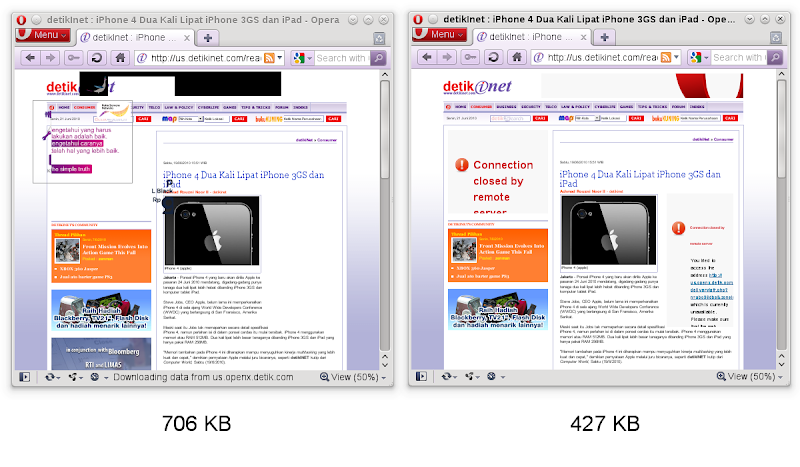
It is unheard that content filtering can dramatically improve your browsing experience. Because it cuts the bandwidth usage, it does translate to lower cost for those who are not lucky enough to get unlimited data plan. But most importantly, throwing garbage out of the web pages definitely speeds up the page loading. For this filterproxy example, I did a very unscientific benchmark and test it with Detik.com news site (now you get the answer why the included blacklist.txt contains only some basic advertisement-laden sites). The screenshots below (click to enlarge) show the unfiltered version (left) and the filtered version (right). Notice also the whopping 40% of bandwith saving!

My promise was to post two variations from that simple proxy example. This counts as one of them, and when the time allows me to clean-up to the other, you'll know it. Stay tuned and happy proxying!

spring-to-summer: photo blog

Since I've not been blogging for a while, let me do a post on some pictures (plus the stories) instead.

On a weekend, Balboa Park is a very nice attraction. Rather than explaining it in details, I suggest to just drop the park a visit. Beside a lot of different types of museum, there is also this Japanese Friendship Garden. A small cafe there, the Tea Pavillion, is a very nice place to relax and enjoy the surrounding. They serve sencha and other types of tea. Hungry? Get a rice bowl:

rice bowl

If you are more a beach person instead, then there is a plenty of choices, for example Silver Strand Beach. It is rather small, but it is always a nice spot to enjoy the sunset.

silhouette @ sunset

When I was at Google IO, I took some pictures of the large overhang banners because I wanted to test the 8 megapixel camera of HTC EVO 4G that Google gave away (see more in the complete set):

api

Getting a fantastic gift for the Father's day? Thinking of something for the next Mother's Day? What about a beautiful pendant (get one from LuShae Jewelry) like what my other better half elegantly captured below?

pendant